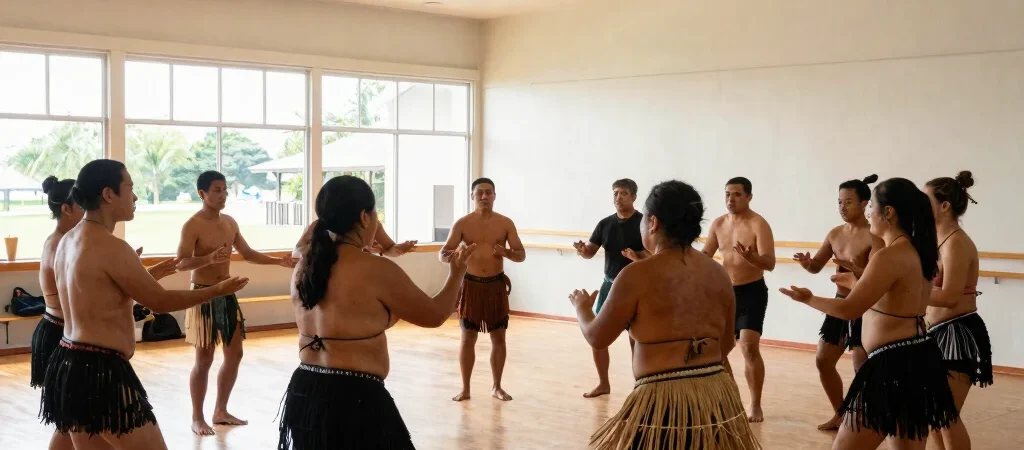
At a kapa haka performance, voices, movement and collective timing can fill a room. It is tempting to treat the moment as a window onto a distant past, but kapa haka belongs to living Māori communities. Its practice connects cultural knowledge with the people who learn, teach and perform it today.
A collective performing practice
Kapa haka refers to Māori performing arts, which can bring together forms such as haka, waiata and poi. A performance does not have to include every form, and the content and presentation vary by group and occasion. Those distinctions matter: kapa haka is not one standardized routine.
Groups may perform in community settings, schools or festivals, where practice involves more than memorizing movements. Participants work on voice, coordination and understanding the material they present. The use of te reo Māori can also make language learning part of the shared work, though the experience differs across groups.
Tradition is not frozen
A living practice can draw on inherited knowledge while continuing to respond to the present. Māori communities and iwi have distinct histories and perspectives, so a performance should be understood in relation to the group presenting it. One event cannot speak for every Māori person.
Public performances can help audiences encounter Māori language and arts, but visibility is not the same as full context. When reporting on a group, identify the occasion and listen to how participants describe their work. Avoid reducing haka to a single dramatic gesture or presenting performance as a substitute for Māori voices.
Follow the people involved
The clearest way into kapa haka is through the people who carry it forward. Notice the group’s words, the setting and what participants say the performance means to them. That approach leaves room for both continuity and change—and keeps the story connected to Māori life now.